



How to Maintain St. Augustine Grass with Once a Week Watering
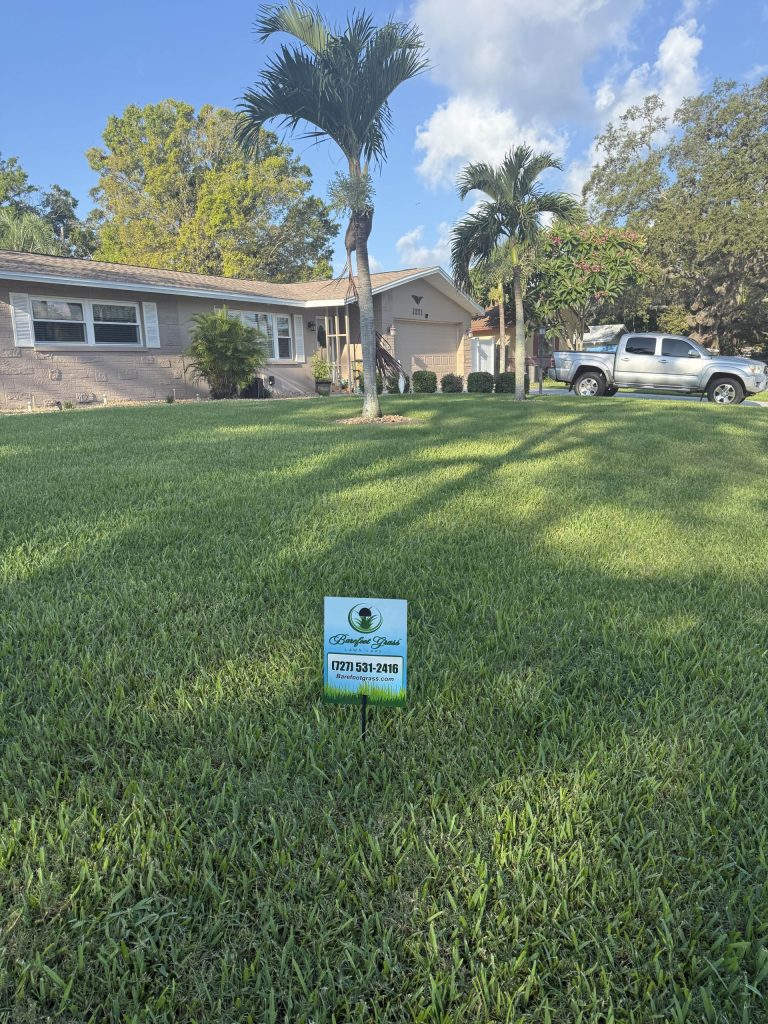
Let’s be honest — once a week watering feels a little absurd when you live on a peninsula surrounded by saltwater, sitting on top of the Floridan Aquifer, one of the largest freshwater aquifers in the world.
That underground river stretches from Georgia all the way down to the Everglades, and from the Gulf to the Atlantic. Pinellas County gets about 48 inches of rain a year. We are not exactly the Sahara Desert.
But here we are. Watering restrictions are real, and if you own a St. Augustine lawn in St. Petersburg, once a week watering is a serious challenge — not because of the heat, not because of the time of year, but because of the ground underneath your feet.
It's All About the Soil
The single biggest factor that determines how long your lawn can go between waterings is the soil — not the weather, not the season, and certainly not your neighbor’s opinion. The soil.
St. Petersburg is built on coastal beach sand. Fine, loose, and beautiful for building sandcastles — terrible for holding water. A heavy clay soil, like what you’d find in the Midwest or South Georgia, can hold moisture for days. Our sand? Not so much. In fact, the sandy soils of Pinellas County can hold enough moisture to keep a St. Augustine lawn healthy for about 72 hours. After that, the lawn starts to stress and decline, especially in the open sun areas.
Think about that. If you water on Monday, your lawn needs water again by Wednesday. Miss that window and your grass starts to struggle. Under a once-a-week restriction, you’re essentially asking your lawn to hold on for five or six extra days beyond what the soil can naturally support.
It’s not impossible to get through it, but you’ve got to be smart about it. Here’s how.
Step One: Get Your Irrigation System in Top Shape
For once a week watering to give your lawn even a fighting chance, your irrigation system has to be performing at 100%. Not 80%. Not “good enough.” One hundred percent.
A broken head, a clogged nozzle, a weeping valve, a busted pipe — any one of those issues can leave a section of your lawn without water for an entire week. That’s a death sentence for St. Augustine in our sandy soil.
You can operate your irrigation for repairs any day. Take advantage of that and run your irrigation to look for problems. Flag anything that’s off — misaligned heads, low-output zones, dry spots. Fix problems as fast as you can. If you have a well and pump system, it may be worth replacing the impeller or upgrading the pump to improve output and coverage.
One of the best and least expensive upgrades you can make is replacing an old mechanical timer with a new smart controller. Today’s smart timers are Wi-Fi connected, and many will send you alerts if a zone fails to run or if a sensor detects a problem. More importantly, you can control your system from your phone while you’re standing in the yard, watching the heads run in real time. No more jogging back and forth to the box to switch stations.
Keep in mind — you’re allowed to test and manually operate your irrigation at any time, as long as you’re present and watching. You can’t just turn it on and go inside to catch the game. But if you’re out there observing, you can run it whenever you need to.
Water at Midnight, Not at 5 AM
A lot of homeowners water at 5 or 6 in the morning because they’ve heard that watering at night causes fungus. That is a myth. It rains at night in Florida constantly, and nobody wakes up to a dead lawn because of it.
What watering at midnight does do is give your lawn water as early as possible on your watering day, shortening the drought gap from the last watering cycle. If you’re on reclaimed water, pressure is also best right after midnight — nobody else is drawing from the system at that hour.
Want to stretch it even further? Water again just before midnight on your watering day. That bookends the day with water, giving your lawn the maximum benefit within your one allowed watering window.
Step Two: Raise the Mowing Height
This is the single most impactful thing you can do to help your lawn survive once a week watering, and most homeowners have no idea.
A tall St. Augustine canopy — at least 5 to 6 inches from the soil surface to the tip of the leaf blade — acts like an insulating blanket over the soil. It keeps the ground shaded, cooler, and moist for longer. A short lawn does the opposite. When grass is cut too low, the sun bakes the soil directly, moisture evaporates fast, and the lawn heats up and stresses out quickly.
There’s an important distinction to understand here. Your mower has a bench setting — that’s the distance between the blade and a flat surface like your driveway. But your actual canopy height, meaning how tall the grass really is, depends on the weight of the mower, how the mower is set up, and the density of your turf. You might have the deck set at 4 inches and your grass is only coming in at 2 to 3 inches tall. What matters is the canopy height — get a ruler and measure from the soil up to the tip of the blade. Aim for 5 to 6 inches, minimum.
Beyond helping with water restrictions, a taller lawn is genuinely a better lawn. It’s greener, thicker, crowds out weeds, and holds up better under stress of any kind.
Step Three: Go Easy on the Lawn
During periods of water stress, your lawn is already working hard just to survive. This is not the time to throw a backyard party, let the kids use it as a soccer field, or drag heavy equipment across it. Traffic compacts the soil and breaks down the grass blades, making it harder for the turf to recover between waterings.
If you can keep foot traffic to a minimum on the days leading up to your next watering, you give the lawn a better shot at coming through in good shape.
Your Drought-Survival Game Plan
Once a week watering is tough on St. Augustine in St. Petersburg — no sugarcoating it. Our sandy soil just isn’t designed to hold water that long. But with a well-tuned irrigation system, smart timing, a taller mowing height, and a little extra TLC, you give your lawn the best possible shot at making it through the restriction period in good shape.
Droughts don’t last forever. We live in Florida. The rain will come back. In the meantime, work smarter with what you’ve got. While you handle the mower, a professional lawn care service focused on nutrition and soil health ensures your St. Augustine has the deep roots necessary to survive these restrictions.”

